
Get More Clicks for Your Online Store Without Ranking Higher
One line of text decides how many searchers pick your store in Google. The formula, five real rewrites, and how to measure the change in Search Console.

You do not need to rank higher to get more traffic from Google.
That sentence sounds wrong. Most store owners believe Google traffic works like this. More visitors means better rankings, better rankings mean months of SEO or an agency retainer, so the realistic option is ads. The first part of that chain is broken, and the break is where this post lives.
Your Google traffic is two numbers multiplied, not one. How many people see your result, and what percentage of them click it. That second number is called CTR, click-through rate, and it deserves one plain sentence because everything below moves it. If 100 people see your store in the results and 4 click, your CTR is 4 percent. Position decides how many people see you. The title decides how many of them pick you.
And the title is not a ranking prize you wait for. It is a text field in your shop platform. You can edit it this afternoon.
Here is what that lever is worth in plain arithmetic. Say a category page shows up in 1,000 searches a month, Search Console calls those impressions, and it sits at position 6 with a default title, so 2 percent of people click. That is 20 visitors. Rewrite the title so it answers what the searcher typed, CTR moves to 4 percent, and the same page at the same position brings 40. Nothing else changed. One sentence did.
That is the promise in my headline made concrete. More clicks, same rankings. Going from 2 to 4 percent doubles your visitors, and on a broken title that is a realistic outcome. On a title that is already decent, the gains are smaller. Doubling is what happens when you fix something bad, not a guarantee stapled to every page.
One more piece of honesty before the how-to. A title cannot rescue a page nobody sees. If you rank on page four, this is not your first move, and if you sell something nobody searches for, no headline invents demand. This lever works where you already have impressions. Almost every store has more of those than its owner thinks, and Search Console will show you exactly where. We will get there.
How common is the problem
This summer I reviewed 197 online stores across the UK, Australia and New Zealand. 30 of them had title tags actively working against them. The brand name first on every page, one title copied across dozens of pages, or the platform default nobody ever touched. And 30 understates it. My method logged one main finding per store, the single most damaging thing I saw, so those 30 are stores where the title was the headline problem. Stores where a weak title merely hid behind a bigger one are not in that count.
Want to know which group you are in? In Google, type site: followed immediately by your own domain, with no space, and read the blue lines. If they read like labels a customer would click, you are ahead of most. If they read like an inventory list, keep reading.
Cards on the table
Titles are part of every store audit I do, and last Tuesday they were Fix 1 on my list of seven, because nothing else in SEO pays back faster. Today is the full version of that first fix. The anatomy, the formula, real rewrites, and the measurement. Everything below you can do yourself, without buying anything from me or anyone else.
What the title tag actually is
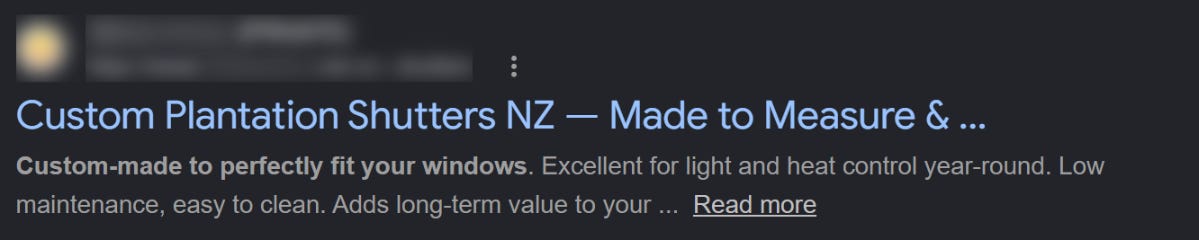
The title tag is the blue line of your Google result and the text on the browser tab. For Google, it is the strongest single sentence on the page. For the searcher, it is your shop window, the only thing they compare, side by side, against four competitors before choosing where to click.

Your platform already has a field for it on every page. Shopify calls it the SEO title, in the search engine listing section at the bottom of each page and product. WooCommerce shows it in the SEO plugin box under the editor. No code, no developer.
The formula
One page, one title, built in this order.
The words your customer types. Not your internal category name. Nobody searches “Our Collection”. They search “womens linen dresses”. Front load these words. Long titles get cut from the end, and searchers scan the first two or three words of each line, so the front of your title is the only part you can count on being read.
One specific detail that wins the click. A number, a size range, a guarantee, a shipping promise. “Sizes 6 to 24”, “3 Year Warranty”, “Ships Overnight”. Specifics beat adjectives; nobody clicks “quality products”.
Your brand, at the end. It belongs in the title, it builds recognition, but it earns the click only after the searcher knows you have what they typed.
For length, aim for about 55 characters and treat 60 as the ceiling, because Google starts cutting beyond that. This is not just my habit. Cyrus Shepard’s team at Zyppy studied 80,959 title tags and found that titles between 51 and 60 characters were the least likely to be rewritten by Google, while titles over 70 characters got rewritten 99.9 percent of the time. Write long, and the title Google shows is no longer the one you wrote.
Five rewrites from the 197 reviews
These are the patterns I found again and again. Store names are invented, the patterns are real.
The brand-first homepage. Before: “StoreName | Home”. After: “Hiking Boots and Trail Gear NZ | StoreName”. The before tells the searcher nothing they can compare. The after answers the search and still carries the brand.
The one-word category. Before: “Products”. After: “Garden Furniture Sets, 5 Year Frame Warranty | StoreName”. A title that could sit on any store in the world sells none of them.
The manufacturer copy-paste. Before: “XR200 Pro”. After: “XR200 Pro Dehumidifier for Damp Rooms | StoreName”. The model number alone reaches only people who already know the product. Adding what it is and what it solves reaches everyone else, and that text is also exactly what AI assistants quote.
The keyword stuffer. Before: “Work boots, buy work boots online, cheap work boots, best work boots”. After: “Mens Steel Toe Work Boots, Ships Same Day | StoreName”. Stuffing reads as spam to people and triggers rewrites from Google. One clean phrase plus one reason to click beats four repetitions.
The 90-character epic. Before: a title so long Google cuts it mid-sentence with three dots, usually right before the part that mattered. After: the same message trimmed to 58 characters with the selling point moved to the front. If your argument lives at the end of a long title, nobody ever sees it.
Why Google rewrites titles, and how to keep yours
In that same Zyppy study, Google rewrote 61.6 percent of all titles, and the habit is growing. Another analysis published on Search Engine Land put the figure at 76 percent by early 2025. Those numbers scare people into thinking the field does not matter. The opposite is true. Rewrites cluster around bad titles. Too long, too short, stuffed, or mismatched with the page. Three habits keep your version on screen.
Stay in the length window. 51 to 60 characters had the lowest rewrite rate in the study.
Match your H1 to your title. When the main heading on the page says the same thing as the title, Google trusts both more. In the study, numbers survived in titles 97.3 percent of the time when the H1 carried them too.
Skip the decoration. Square brackets got rewritten 77.6 percent of the time. And if Google swaps your pipe separator for a dash, ignore it, that swap is cosmetic and changes nothing about your clicks or rankings.
The bonus I am not counting
Everything above holds your position constant, and the headline promises exactly that, more clicks without ranking higher. But you deserve the whole picture, because a better title rarely holds position constant for long.
Two things happen after a rewrite. The first is official. The words in your title tag are a ranking signal. Google has confirmed it, and putting what your customer types at the front of the title is the cheapest statement of relevance a page can make. A modest signal, not a magic one. The second is bigger and less official, the clicks themselves. Google publicly downplays click behaviour as a ranking factor, and many experienced SEOs put it near the very top of their list anyway. I will not settle that argument in a newsletter. I will just say that in my reviews and my own work, titles that win clicks tend to be followed by better positions.
And better positions pay disproportionately, because the click curve is steep. FirstPageSage’s meta-analysis of click-through rates puts the average number one result at 39.8 percent of all clicks, number two at 18.7, number three at 10.2, and number six at 4.4. One position up near the top can roughly double your visitors. That curve also tells you why the numbers in my opening example were realistic rather than generous. The average result at position 6 earns 4.4 percent, so a default title limping at 2 percent is not a pessimistic invention.
So the math in this post deliberately counts only the first effect, more clicks at the position you already hold. When the second effect shows up a few weeks later, consider it interest on the same afternoon of work.
How to measure the change
This is the part almost nobody does, and it is the part that turns a text edit into evidence.
Open Google Search Console, Performance report. Click on a page you rewrote, then look at two numbers for that page, impressions and CTR. Note them down, with the date. Google has to recrawl the page first, so give it 2 to 4 weeks, then compare the same 28-day window before and after.
What you want to see is CTR up while average position stays roughly where it was. That is the clean signature of a better title, more clicks from the same visibility. If average position then starts creeping up over the following weeks, that is the second effect from the bonus section arriving. Take it, but keep judging the title itself by CTR. If impressions are near zero, you have learned something too. That page has a ranking problem, not a title problem, and now you know where that page stands.
Start with your 20 most important pages, sorted by impressions in Search Console, not by your own feelings about which pages matter. The page with 5,000 impressions and a default title is worth more of your afternoon than the homepage you already polished.
Quick questions, quick answers
Will Google just rewrite my title anyway?
For most pages, yes. But from what I see in store reviews, Google mostly rewrites the titles that deserve it, too long, too short, stuffed, or saying something different from the page itself. Keep yours around 55 characters, make your H1 say the same thing, put the search words first, and in my experience Google then shows exactly what you wrote.
Do I need a developer for any of this?
No. The field exists on every page of every major shop platform. This is typing, not coding. The only technical neighbour is the H1 match, and that is usually just the page name.
How much can CTR really move?
From broken to well written, doubling is realistic, which on a 2 percent page means 2 more visitors per 100 impressions, forever, for free. From decent to good, smaller single digit gains. Anyone promising an exact number before seeing your Search Console is guessing. I will not.
Does any of this matter for AI search?
More every month. Assistants like ChatGPT and Perplexity lean on the same signals when they describe and recommend stores, and a title that says what the page sells is the single easiest thing for them to quote. The 15-minute check from two weeks ago shows where you stand in AI answers; clean titles are part of how you move.
Want your titles reviewed for you?
Do the site: check today. Rewrite your top 20 this week. Note your Search Console numbers before you start. That is the whole method, and it is free.
If you would rather have a second pair of eyes first, I do a free version of exactly this. Send me your store through the button below and I will record a short video, about five minutes, showing what your titles look like in Google right now, side by side with the stores you compete against, which ones are costing you clicks, and the rewrite I would start with. No call, no obligation, plain language.
And if this post was useful, forward it to one store owner whose Google results still say “Home”. You now know exactly what that is costing them.
Neven Lovreković
Ecommerce SEO Strategist and founder of Lobit
neven-lovrekovic.com · LinkedIn
P.S. If you only remember one thing, your Google traffic is impressions times click rate, and the second number is a text field you control. Before you spend anything on ranking higher, spend an afternoon making the rankings you already have earn their keep.
---