Why Your Online Store Is Losing Google Traffic to AI (and the 15-Minute Check That Shows How Much)
No paid tools, no jargon. Fifteen minutes and five prompts show you exactly where you stand.

Try something before you read any further.
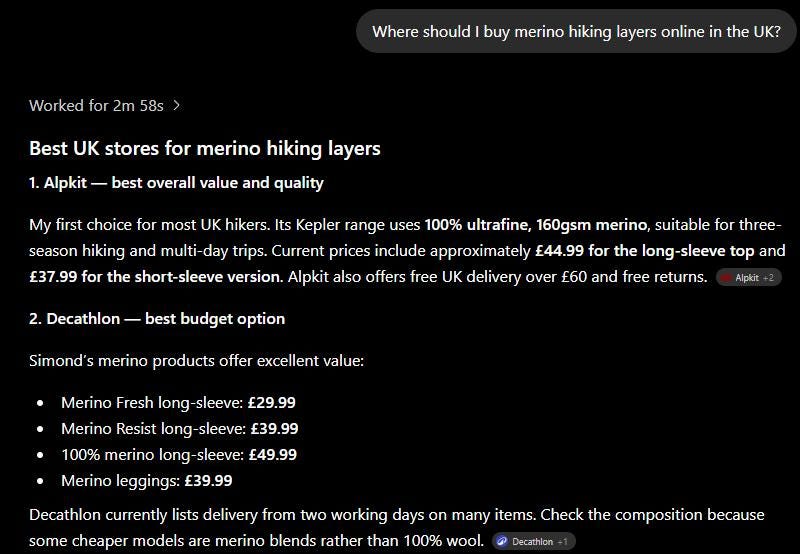
Open ChatGPT and ask it the question your store lives off. Not your brand name, the real buying question a stranger would type. Something like “best merino hiking layers in the UK” or “best eco kitchen products that ship to New Zealand”.
Read the answer. It is long, confident and specific. It names products. It names stores.
Now the uncomfortable question: is yours in it?
Most owners I talk to have never looked. Their future customers look every day.
What actually changed
AI search is the new layer between you and your customer, and it has two faces. Google now shows AI Overviews, a written answer at the top of many searches, above the first result. And assistants like ChatGPT, Gemini and Perplexity answer buying questions directly, usually by naming three to five stores and products.
The work of making sure your store is one of the names inside those answers has an industry name: GEO, generative engine optimization. That is as much jargon as you will get from me today. Think of it as SEO with a second scoreboard.
Here is why this costs you money even when your rankings look fine:
When an AI Overview answers “what to look for in X” well enough, part of the people who used to click your buying guide simply stop clicking. Your position holds. Your clicks drop.
When an assistant recommends stores, the shortlist forms before anyone opens a browser tab. If you are not on it, you were never in the running, and no analytics report will tell you.
This is not the end of Google traffic. It is a quiet tax on it. And it grows a little every month.
The part nobody tells store owners
Before you spend anything on this, one thing from practice.
This summer I reviewed 197 online stores across the UK, Australia and New Zealand. The finding that mattered most had nothing to do with AI: 62 of those stores were selling with the manufacturer’s product description, word for word. Dozens of sites, identical text.
Google has to pick one of those identical pages, and it is rarely the small store. An AI assistant is even stricter. It builds answers from pages that actually say something: a real comparison, a real spec, a real answer to a real question. If your page carries the same text as dozens of competitors, there is nothing left to quote. So you don’t get quoted.
That is the good news hidden in all of this. Most stores losing AI visibility are losing it for old-fashioned, fixable reasons.
The 15-minute check
You need a timer, a notebook and 15 minutes. If you use Google Search Console, keep it open too. Nothing else.
Step 1, about five minutes: ask ChatGPT.
Run these five prompts, filled in for your niche:
Best [your product type] for [your main customer] in [your country]
Where should I buy [your product type] online in [your country]?
[A product you sell] vs [the rival product your buyers compare it with], which should I buy?
Is [your store name] legit?
Best alternatives to [your biggest competitor]
One line per answer is enough: did my store appear, yes or no, and which stores did.
Then count. The number of answers that mention your store, 0 to 5, is your score. Write it down.
If you want the full picture later, repeat the same five prompts in Gemini and Perplexity. Useful, but optional, and not part of the 15 minutes.
Step 2, about five minutes: look at your own Google results.
Google the three searches that bring you buying customers, the ones people type when they are ready to spend. For each one: is there an AI answer at the top of the page? Does it fully answer the question? And is your site one of the small source links inside it, or is a competitor?
Step 3, about five minutes: open Google Search Console.
If you don’t use Search Console, skip this step. Steps 1 and 2 already answer the main question, and setting it up properly is a post of its own.
If you do: open Performance, then Search results, and set the date range to compare the last 6 months with the previous 6. Look at your most visited pages for one pattern: impressions holding or rising while clicks fall. An impression means your page showed up in someone’s results. A click means they actually came. A page that keeps its position but loses clicks is the signature of an answer taking your visitor before they reach you.
This step is also where “how much” gets a number. Take one page: if clicks fell from 500 to 300 a month while impressions held, that single page is losing around 200 visits a month to answers. Do the same for your top three pages and you are holding a number, not a feeling.
Whatever you found, write it down with today’s date. That is your baseline. Repeat the same 15 minutes every three months and you will know exactly which way this is moving for your store, while your competitors keep guessing.
What you will probably find
Most stores land in one of three places.
You show up in some answers. Good. Protect it, those pages deserve your attention first.
You don’t show up, but competitors do. Now you know who and where, which is more than most owners know. The fixes are concrete, and we will cover them here one per week.
Nobody from your niche shows up. That is an open market. In the answers I check, the same names keep coming back once they get in. There is something to be said for getting there first.
What happens here every Tuesday
This is the first post of a weekly series. Every Tuesday, one practical way to make your store more visible in Google and in AI answers. Written for owners and marketing managers of small and mid-size online stores, not for SEO professionals. Everything comes from real store reviews and real numbers, like the 197 above, and none of it needs a big budget.
Next Tuesday: the seven low-hanging fixes I check first in every store, ordered by how fast they pay back.
Quick questions, quick answers
Does AI search replace SEO?
No. AI assistants find and read your pages much the same way Google does. Good SEO is still the entry ticket. Getting quoted in the answers is the new prize on top of it.
My store is small. Does this matter yet?
Measured in today’s visits, less than the headlines claim. Measured in direction, a lot. The shortlists are forming now, and they are easier to enter early.
Which assistant matters most?
The one your customers use. In practice, start with ChatGPT, and watch Google’s AI answers closely because they sit inside the search you already depend on.
Want me to run this check for your store?
I do it free. Send me your store through the button below and I will record a short video, about five minutes, showing where your store is leaking Google visitors and the one fix I would start with. No call, no obligation, plain language.
Neven Lovreković
Ecommerce SEO Strategist and founder of Lobit
neven-lovrekovic.com · LinkedIn
P.S. If you only take one thing from this post, take the five prompts. Your score, 0 to 5, written down with today’s date, is a baseline most of your competitors will never bother to get. Everything we do here in the coming weeks builds on knowing where you actually stand.