

One of the stranger things I found while reviewing 197 online stores this summer had nothing to do with rankings.
Some stores were not even naming themselves consistently.
One shop used its bare domain at the start of the homepage title instead of the brand name. Another had a stray character sitting in front of the brand because a template prefix had been left empty. A third had one of its own product words misspelled across the site, and it had apparently been that way for years.
These are small mistakes. None of them is going to destroy an SEO strategy.
But the homepage is one of the main places Google uses to understand what a site is called. If the name is already messy there, I want to know what happens when I look outside the website.
The marketplace account.
The review profile.
An old directory listing.
A social account somebody created three years ago and never looked at again.
That is usually where the variants start piling up.
The same store might appear as Brand Name, BrandName, Brand Name Ltd, and brandname.com, depending on where you look.
Nobody intended to create four versions. They just accumulated.
Start with what Google actually says
Google has documentation specifically for site names.
Its system looks at the homepage and at references to the site elsewhere on the web. On the homepage itself, it can consider WebSite structured data, og:site_name, the page title, headings and other text.
Google also says that WebSite structured data is the most important of those sources when you want to specify a preferred site name.
And if Google is not confident enough in the name you provide, it may generate a different one from the other sources available to it or show the domain instead.
That does not mean inconsistent naming creates a penalty.
It means there is very little upside in making Google work out which version you actually use.
The same principle is useful beyond traditional Google results. Any system retrieving information about your business from several public sources has an easier job when those sources describe the same company in a consistent way.
I would treat that as basic identity cleanup rather than some new form of “AI SEO”.
Check yours in thirty seconds
Search for your store by name in Google.
Look at the site name displayed above your result. Do not confuse it with the blue title link underneath it.
Does Google show the name you actually use with customers?
Then open your homepage and check how the brand appears in the title, main heading and visible copy.
If everything matches, good.
If you already have two or three versions before leaving your own site, keep reading.
How I would clean it up
There are three parts.
Step 1. Decide what the primary name actually is
Pick the version customers know you by.
Google recommends using a concise, commonly recognised site name. Its own example is “Google” rather than “Google, Inc.”
That is a useful rule for ecommerce stores too.
Your registered company might be Example Commerce Holdings Limited while every customer knows the shop as Example.
Those two names can coexist. They just have different jobs.
Use the trading or brand name consistently as your primary public name. Keep the registered company name for places where the legal entity matters.
If you genuinely use another recognised version of the brand, Google also supports alternateName.
Step 2. Give the business one clear description
Write a short description explaining what the store sells and, where relevant, where it delivers.
Do not try to make it clever.
Something like:
Example sells handmade leather bags and accessories online, with delivery across the UK.
You do not need to paste the exact same sentence everywhere.
In fact, forcing identical copy into every profile can make the result sound unnatural.
What should stay consistent are the facts.
What you sell.
Who the business is.
Where you operate.
If one profile says you manufacture the products, another says you are a retailer, and a third describes a completely different product range, that is a more useful problem to fix than whether somebody changed one adjective.
Step 3. Fix the sources you control first
I would start with the homepage.
Google’s site name documentation specifically points to WebSite structured data on the homepage. Make sure its name contains your preferred site name and its url contains the canonical homepage URL.
Then look at your organization markup.
Google recommends using the most specific Organization subtype that fits the business. For an ecommerce site, its documentation specifically recommends OnlineStore.
For this particular cleanup, I would pay attention to a few properties.
Use name for the name of the organization and keep it consistent with the site name you are using.
If the registered company name is genuinely different, that is what legalName is for.
Use url for the organization’s website.
Then check sameAs.
This is one of the more useful properties for a business that already exists in several places online.
Schema.org defines sameAs as a URL pointing to another page that unambiguously identifies the same thing. Google’s Organization documentation gives social media and review profiles as examples, and allows multiple sameAs URLs.
So if your business has genuine profiles elsewhere, you can connect them in the markup.
It is not a magic ranking signal.
It is simply a clean way to tell a machine that these external profiles refer to the same organization.
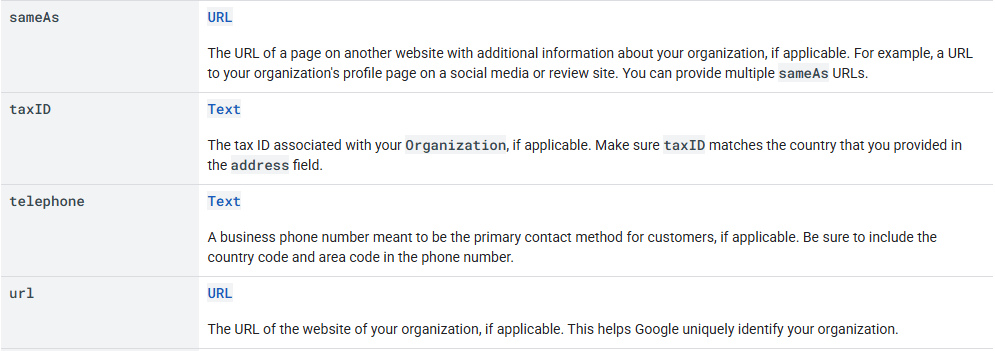
sameAs lets you connect your organization to profiles that represent the same business elsewhere on the web.After that, work through the external sources you can edit.
Marketplace profiles, review sites, social accounts and legitimate business directories are the obvious places to start.
Keep the primary brand name consistent unless a platform has a genuine reason to require the legal entity name.
The ten minute audit
Search your brand in Google and go through the first couple of pages.
You are looking for your business, not for rankings.
Write down every version of the name you find and where it appears.
Then check the places you already know about: marketplace shops, review profiles, social accounts, directory listings and supplier or stockist pages.
You might find nothing.
That is a perfectly good result.
Or you might discover that the business has been operating under three or four slightly different identities depending on which page somebody happens to land on.
At least then you know what needs cleaning up.
The questions I get asked
Do I need a developer?
Probably not for most of it.
Profiles and listings are usually simple edits. Structured data depends on your platform. Many ecommerce systems already generate it through the theme, an app or an SEO plugin.
If you are changing schema, test the implementation afterwards rather than assuming the platform got it right.
How long before Google picks up the changes?
Do not expect an immediate change.
Google says recrawling and processing site name changes can take anywhere from several days to several weeks. External platforms will have their own timelines.
I also would not judge this work by looking for an instant ranking increase.
The point is to remove unnecessary ambiguity around the business and its name.
My legal company name is different from the shop name. Is that a problem?
No.
That is exactly why legalName exists separately from name.
Use the public brand where the brand belongs and the registered company name where the legal entity belongs.
Should I really spend time doing this?
That depends on what else is wrong with the store.
If your products are barely indexed, your category structure is broken or Google cannot crawl important pages, fixing an old Facebook profile is unlikely to be the best use of your afternoon.
That is the part that matters.
The changes themselves are easy. Knowing whether they deserve to be near the top of your list takes a little more context.
What I would do this week
Start with your own site.
Check the site name Google is showing. Check the homepage title, headings and visible brand name. Then inspect your WebSite and organization structured data.
Once those agree, move outside the site and clean up the profiles people are actually likely to find.
You do not need to fix every forgotten directory entry on the internet before anything improves. Start with the sources you control and the profiles that are still visible.
Most stores can get the important part done in an afternoon.
If you would rather have someone look first, I will do the looking.
Send me your store and I will send back a short video walking through what I find, including whether inconsistent naming is actually worth your time or whether something else should come first.
It is free. There is no call to book.
If the video tells you nothing you did not already know, say so and I will not send you anything else.
[Get your free store analysis]
If you are not ready for that, stay on the list.
Next week I am publishing the full write-up of all 197 stores, with the findings sorted by how much each one costs.
Neven Lovreković
Ecommerce SEO Strategist and founder of Lobit
neven-lovrekovic.com · LinkedIn
P.S. Last week I listed five things I would check when trying to improve an online store’s visibility in AI answers. Naming consistency was the cheapest one on the list.
I still think it is.
For most stores, this is an afternoon of checking pages and updating profiles. Once the important sources agree, there is very little ongoing work to do.