

One of the easiest AI SEO services to sell right now is a file called llms.txt.
It sounds convincing. Put a file on your server, explain your site to AI systems, and improve your chances of appearing in their answers.
There is just one problem. Nobody has shown that a major consumer AI platform uses your llms.txt file to decide which store or product to recommend.
Google has gone further. Its documentation for AI Overviews and AI Mode says you do not need a new machine-readable AI file to appear in those results. John Mueller called llms.txt “purely speculative” in June.
I am not saying the file is harmful. If you already have one, leave it there.
I just would not pay someone to make it the centrepiece of an AI search strategy.
There are much more useful things to work on first.
And unlike llms.txt, several of them are documented directly by OpenAI, Google and Perplexity.
Try this before reading the rest
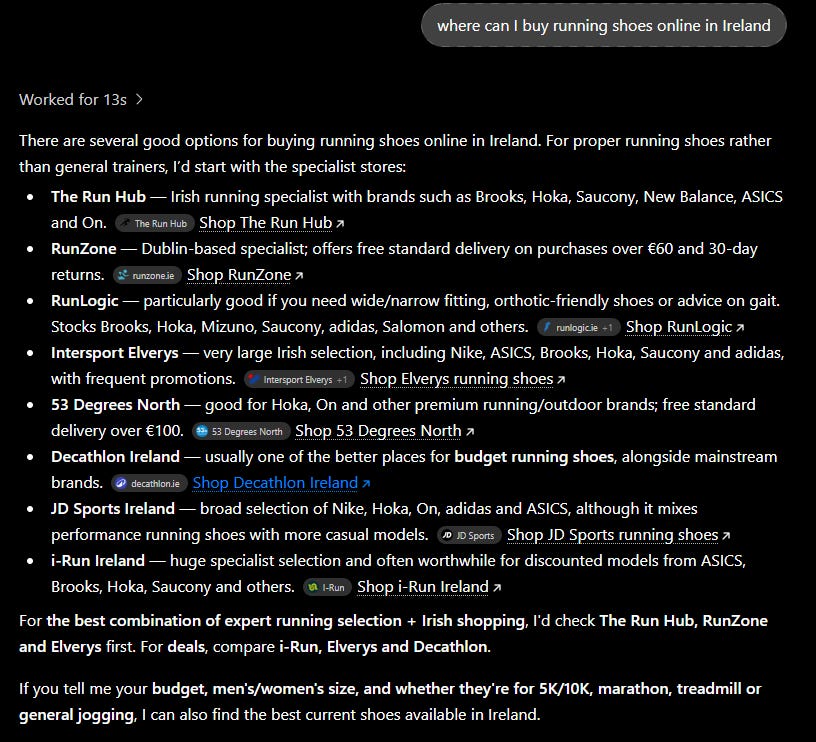
Open ChatGPT and ask a question the way one of your customers would.
For example:
where can I buy running shoes online in Ireland
Replace running shoes with your category and Ireland with your main market.
Look at the stores it names.
If yours is there, save the answer.
If competitors appear and you do not, save that too.
And if ChatGPT falls back to Amazon, eBay or another huge marketplace without naming specialist stores, that is useful information as well.
One answer is not a benchmark. AI answers change between runs. For now you are simply checking whether your store is even in the conversation.
Start with what OpenAI actually says
There is a useful distinction here that gets lost in most discussions about AI visibility.
ChatGPT can mention a store in a normal web answer, and it can also show products and merchants through its shopping experience.
Those are related, but they are not exactly the same thing.
For its shopping experience, OpenAI publishes more detail than most store owners realise.
ChatGPT can use structured product metadata from first-party and third-party sources. When several merchants sell the same product, OpenAI says merchant ranking can consider availability, price, quality and whether the seller is the maker or primary seller.
It also states clearly that organic product results are selected independently and are not influenced by OpenAI partnerships.
That matters.
You cannot simply buy the first organic position in ChatGPT Shopping.
You can, however, give the system better information about what you sell.
That is where I would start.
1. Make your product data easy to use
A recommendation system has a difficult job if your product information is incomplete or outdated.
Price matters. Availability matters. Product descriptions matter. Images matter. Variants matter.
If you use Shopify, there is a useful shortcut here. OpenAI says Shopify product data is already integrated into ChatGPT through Shopify Catalog and individual merchants do not need to create a separate integration for that data to be available.
For other platforms, OpenAI has its own merchant registration and product feed system.
I would not manually build a feed from scratch just because AI search is fashionable. First check what your platform already sends and whether the important fields are accurate.
Google is moving in the same direction. Merchant Center data now matters across AI-driven shopping experiences, including AI Mode, and Google has started adding product attributes specifically designed for conversational discovery.
Perplexity also has a Merchant Program. It is free, although the original programme was aimed primarily at larger retailers, so a small independent store should not build its entire strategy around being accepted.
The practical point is simpler.
Before looking for a new AI optimisation tool, make sure the product information you already publish is accurate.
A feed gets your products into the pool of information a system can use.
It does not guarantee that you will be the store it chooses.
2. Make it obvious that all of your profiles describe the same business
This one is partly SEO, partly basic brand hygiene.
Search your business name.
Then check your website, Google Business Profile if you have one, social profiles, review profiles and major directories.
Is the business name written the same way?
Does each profile point to the correct website?
Do they agree about what you sell and where you deliver?
I would fix inconsistencies before doing anything clever.
I would not worry about using an identical 20-word company description everywhere. That is too mechanical.
The goal is simply to remove ambiguity.
If your website calls the company ABC Running, Instagram calls it ABC Shoes Ireland and a review profile still uses an old company name, fix it.
This takes very little money and it also helps outside AI search.
3. Give AI systems evidence that does not come from you
This is where AI visibility becomes harder to manufacture.
Peec AI analysed 30 million cited sources across ChatGPT, Google AI Mode, Gemini, Perplexity and AI Overviews earlier this year.
The three most cited domains overall were Reddit, YouTube and LinkedIn.
The mix changes by platform. ChatGPT leaned more heavily towards sources such as Wikipedia, Reddit and editorial publications. Perplexity’s top sources included Reddit, YouTube, LinkedIn, Wikipedia and G2.
That does not mean a Reddit mention automatically makes ChatGPT recommend your store.
It does show something useful though.
AI answers use far more than the claims businesses make on their own websites.
A product page saying “fast delivery” is your claim.
Independent reviews repeatedly mentioning fast delivery are different evidence.
The wrong response is to create ten Reddit accounts and start dropping links. Apart from being obvious spam, it gives you exactly the reputation you do not want.
The better approach is slower.
Answer questions in communities where you genuinely know the subject.
Ask customers for honest reviews rather than scripting what they should say.
Publish useful product demonstrations or comparisons on YouTube when video makes sense for your category.
Give people a reason to mention you without having to manufacture the mention yourself.
4. Put useful product information in the page itself
A lot of ecommerce product pages still make the machine do unnecessary detective work.
The specifications are inside an image.
The important compatibility information is hidden in an accordion.
The description is two sentences copied from the manufacturer.
The difference between this product and the next model up is never explained.
Google’s own guidance for AI search is very ordinary here. Important information should be available in textual form, structured data should match what is visible on the page, and product information should be kept current.
That is good advice for ChatGPT and Perplexity too.
Take your bestselling product and check the page.
Can I tell what it is within a few seconds?
Are the important specifications written as text?
Does the page answer the question somebody would normally ask before buying it?
If there is an obvious alternative product, does the page explain the difference?
Last month I wrote about title tags and how one line can change which Google result somebody clicks.
This is the next layer.
A good title helps someone choose your page.
A useful page gives search systems something worth extracting, citing or summarising after they arrive.
5. Check whether you are blocking the systems you want visibility from
This is the technical check I would do before paying for anything.
But the crawler names matter.
For ChatGPT Search, the important crawler is OAI-SearchBot.
OpenAI explicitly says sites that opt out of OAI-SearchBot will not be shown in ChatGPT search answers, although a navigational link can still appear in some circumstances.
GPTBot is different.
GPTBot is used for content that may be used to train OpenAI’s foundation models. You can block GPTBot while allowing OAI-SearchBot. OpenAI treats those as separate choices.
For Perplexity, check PerplexityBot.
For Google’s AI Overviews and AI Mode, check whether normal Googlebot crawling and indexing are allowed. Google-Extended is a different control and is not what determines eligibility for AI Overviews or AI Mode in Google Search.
That distinction is easy to miss, and it is one reason I would not blindly copy a generic “AI robots.txt” template from another site.
Also check your CDN or firewall.
A perfect robots.txt file does not help much if Cloudflare or another security layer blocks the crawler before it reaches the page.
What I keep finding in real stores
I have manually reviewed 197 small and mid-sized online stores across the UK, Australia and New Zealand.
These were screening reviews rather than full client audits. I recorded one main problem per store, so the numbers I publish from that project are deliberately conservative.
One pattern is particularly relevant here.
In 62 of those stores, I found product descriptions that appeared verbatim elsewhere on the web, often because several retailers were using the same supplier copy.
Think about what that leaves an AI system to work with.
Five stores sell the same product.
Five pages contain almost identical text.
None of them explains who the product is actually for, when I should choose it, what it is better at, or what I should buy instead.
There is very little original information there to retrieve.
AI did not create that problem.
Ecommerce stores have been copying supplier descriptions for years.
AI search has simply given store owners another reason to finally fix it.
Is GEO actually different from SEO?
Less than the current marketing suggests.
Most of what I have described here was already good SEO.
Crawlability.
Useful product information.
Structured data.
Merchant feeds.
Brand consistency.
Authority outside your own website.
The difference is the interface.
Google used to make users choose between a long page of results. An AI answer can reduce that choice to a much smaller set of stores, products or cited sources.
That makes being absent more noticeable.
It also makes measurement harder because the answers are not deterministic.
How long does this take?
There is no honest universal answer.
You can check robots.txt today.
You can fix inconsistent business information today.
Product page improvements can go live this week.
That does not mean ChatGPT will mention you next Tuesday.
Crawlers have to revisit the site, indexes have to update, and the system still has to decide that your page or product is relevant to a future question.
Mentions and reviews outside your own site usually take longer because you cannot manufacture genuine reputation on demand.
Anyone giving you an exact number of days before seeing your store in AI answers is guessing.
Should you create llms.txt?
If you already have one, I would leave it.
If your CMS creates one automatically, fine.
I just would not make it a priority and I definitely would not buy an “AI optimisation package” whose main deliverable is that file.
I would rather spend the same afternoon checking product data, crawler access and the pages that actually make you money.
Do you need an AI visibility tracking tool?
Probably not on day one.
Start with a spreadsheet.
Choose five buying prompts that matter to your store.
Run each one several times because AI answers vary between runs. If possible, use a fresh or temporary conversation and keep the prompt wording the same.
Record the date, the prompt, which stores were mentioned and which sources were cited.
Repeat the test every month.
After a few months you will know whether there is enough movement to justify paying for a dedicated tracking platform.
You will also know exactly what you want that platform to measure.
How I would measure this
I would keep two separate views.
The first is your prompt log.
That answers one question:
Are AI assistants mentioning my store more often?
The second is traffic.
Google Analytics or another analytics platform can show referrals from sources such as ChatGPT and Perplexity.
Google Search Console is useful for Google, but there is an important limitation. Google currently includes traffic from AI Overviews and AI Mode inside normal Web search reporting rather than giving you a clean separate AI Search report.
So do not try to turn one metric into something it is not.
Mentions tell you about visibility.
Referral and search traffic tell you whether that visibility is producing visits.
What I would do this week
Run the buying prompt from the beginning of this post and save the result.
Then open robots.txt and check OAI-SearchBot and PerplexityBot. Make sure Googlebot can crawl and index the pages you actually want visible.
After that, open your best-selling product page.
Look at the price, availability, description, images and product specifications.
Then Google your business name and check whether the major profiles agree about who you are, what you sell and where you sell it.
You can do all of that before buying another AI SEO tool.
If you would rather have someone check the store first, send it to me.
The free store analysis I offer now includes an AI visibility check alongside the SEO review.
I will look at where your store appears, where competitors appear instead, and which of the areas in this post I would fix first.
No sales call is required.
If you are not ready for that, stay on the list.
One of the next posts will cover two settings that can quietly remove ecommerce pages from ordinary Google Search. They are much less fashionable than GEO, and in the stores I review they usually cost more.
Neven Lovreković
Ecommerce SEO Strategist and founder of Lobit
neven-lovrekovic.com · LinkedIn
P.S. If you do only one thing from this post, check crawler access. It takes a few minutes, and there is no point improving pages for an AI search system that you have accidentally told not to crawl them.